California’s 19th-century history compresses an unusual amount of change into a short span — the state went from Mexican territory to U.S. statehood to the epicenter of the largest gold rush in American history in the space of about two years. That speed is part of why the period still shapes how the state sees itself.
Before European Contact
California was home to one of the most linguistically and culturally diverse Native American populations in North America long before Spanish, Mexican, or American arrival. Groups including the Ohlone (San Francisco Bay Area), the Chumash (Central Coast), the Yokuts (Central Valley), and dozens of other distinct peoples developed cultures adapted to California’s varied geography — coast, desert, mountains, and valley — with distinct languages, trade networks, and resource management practices. Estimates of the pre-contact Native population of California run into the hundreds of thousands, among the highest population densities of any region in pre-colonial North America.
Spanish and Mexican Rule
Spain established a chain of 21 missions along the California coast starting in 1769 with San Diego de Alcalá, extending north to Sonoma by 1823. The mission system forced Native populations into labor and religious conversion, and introduced diseases against which Native Californians had no immunity — the demographic impact on Native communities during this period was severe. Mexico won independence from Spain in 1821, taking control of California, and secularized the mission system in the 1830s, redistributing much of the land into large private ranchos.
The Mexican-American War and U.S. Annexation
The United States and Mexico fought the Mexican-American War from 1846 to 1848. The Treaty of Guadalupe Hidalgo, signed February 2, 1848, ended the war and transferred California (along with a large swath of the American Southwest) to the United States. In a striking coincidence of timing, gold was discovered at Sutter’s Mill in Coloma just nine days before the treaty was signed — January 24, 1848 — though news of the discovery hadn’t yet spread widely when the territory changed hands.
The Gold Rush
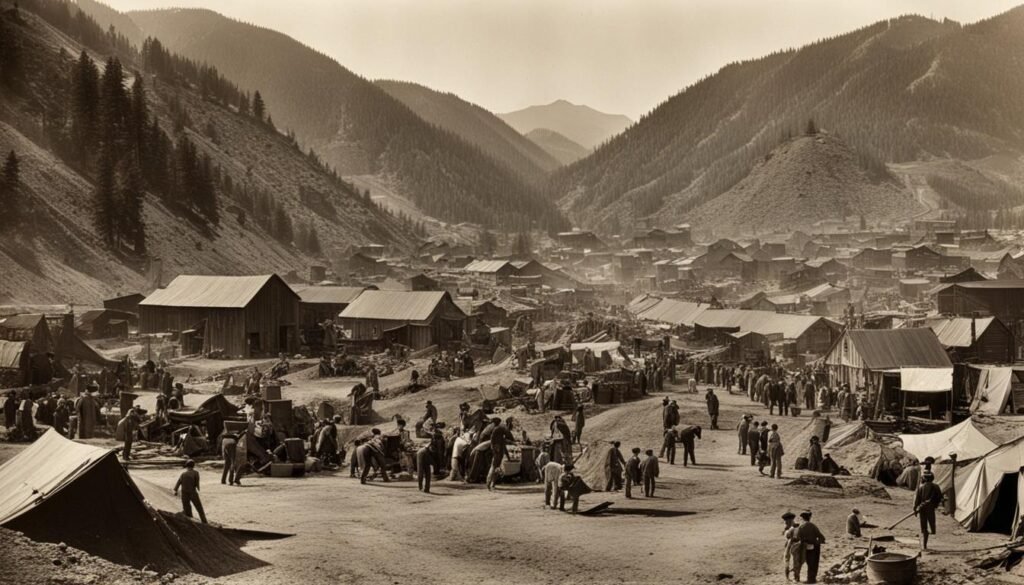
Once word of the gold discovery spread in 1849, it triggered a global migration event: an estimated 300,000 people came to California from across the U.S. and around the world (Latin America, Europe, Australia, and China among the largest sources) in what became known as the Gold Rush, with the newcomers nicknamed “forty-niners” after the year most of them arrived. San Francisco’s population exploded from roughly 1,000 residents in 1848 to around 25,000 by 1850. The rapid population growth, largely bypassing the normal territorial process, was a major factor in California’s fast-tracked path to statehood.
The Gold Rush’s environmental and social costs were severe and often left out of celebratory retellings: hydraulic mining caused significant long-term damage to California’s rivers and landscapes, and the sudden influx of settlers accelerated violence against and displacement of Native Californian communities, contributing to a documented, drastic population decline in the decades following.
Statehood
California was admitted to the Union as the 31st state on September 9, 1850, as part of the Compromise of 1850 — entering as a free state, which was politically significant given the sectional tensions over slavery that would culminate in the Civil War a decade later. Its admission was unusually fast: California skipped the standard territorial phase most states went through, largely because of the Gold Rush population boom.
Why This Period Still Matters
A few threads from this era run directly into how California is understood today:
- The Gold Rush established California’s identity as a destination for reinvention and rapid economic opportunity, a pattern that repeated with later booms in oil, agriculture, aerospace, and technology.
- Mission-era place names (San Diego, San Francisco, Santa Barbara, and dozens of others) trace directly back to this period and remain the state’s dominant naming convention.
- The demographic and environmental costs of this era — particularly toward Native Californians and the landscape — are increasingly part of how the period is taught and discussed, a shift from earlier, more purely celebratory Gold Rush narratives.
Bottom Line
If you’re researching this period further, the key dates to anchor around are the 1848 gold discovery and the 1850 statehood. Those two years explain most of what followed in the state.
FAQ
When did California become a state?
September 9, 1850, as the 31st state, admitted as part of the Compromise of 1850 and entering as a free state.
When was gold discovered in California?
January 24, 1848, at Sutter’s Mill in Coloma — just nine days before the Treaty of Guadalupe Hidalgo transferred California to the United States. The main wave of migration didn’t arrive until 1849.
How many people came to California during the Gold Rush?
An estimated 300,000 people arrived between 1848 and the mid-1850s, from across the U.S. and internationally, including large numbers from Latin America, Europe, Australia, and China.
How many Spanish missions were in California?
21 missions, established between 1769 (San Diego de Alcalá) and 1823 (Sonoma), forming the basis for many of California’s present-day city names.