Joshua Tree National Park sits where the Mojave and Colorado deserts meet, about two hours east of Los Angeles and an hour north of Palm Springs. It is 790,000 acres of twisted Joshua trees, monzogranite boulder piles, and some of the darkest night skies in Southern California. The park rewards a half-day drive-through or a full night of camping; the mistake is showing up in summer midday or without water. Here is what is actually there.
Rock formations
The boulders are the park’s signature, and most are roadside or a short walk in:
- Arch Rock – a natural arch near the White Tank campground; easy flat walk.
- Skull Rock – a rock that looks like a skull, right off Park Boulevard; you drive past it.
- Cap Rock – a short loop with views over the desert; good for sunset.
- Split Rock – a one-mile loop past a split boulder and through a quieter section of the park.
- Hidden Valley – the classic rock-climbing area and a flat, easy one-mile loop; also the main campground hub.

Hiking and wildlife
- Trails. From the flat Hidden Valley loop to the steep, exposed Ryan Mountain (top of which overlooks the park), there is a range of difficulty. The Cholla Cactus Garden is a short walk through a dense stand of the “jumping” cholla.
- Wildlife. Coyotes, desert bighorn sheep (more common in the south), roadrunners, lizards, and a lot of jackrabbits at dusk. Bring binoculars; most animals are active at dawn and dusk, not midday.
- Prepare. Water, sun protection, and sturdy shoes. The desert is hot from May to October and there is almost no shade. Cell service is spotty.
Camping and stargazing
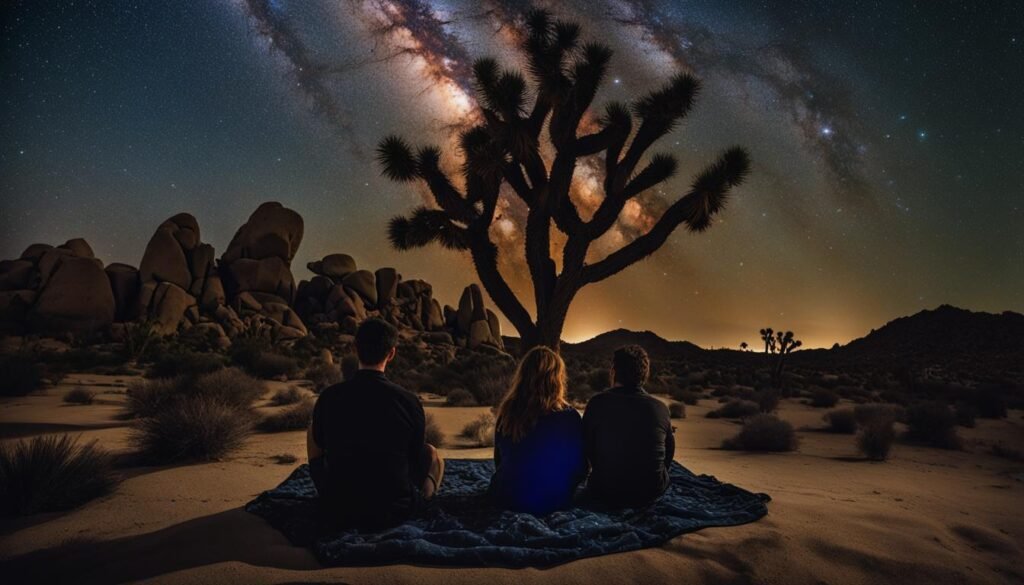
Joshua Tree is a designated International Dark Sky Park, which matters: on a new-moon night the Milky Way is visible without a camera. There are nine campgrounds, from the developed (with flush toilets, first-come or reservable) to primitive. Reservations through recreation.gov fill fast in spring and fall. Backcountry permits are free at the entrance stations.

History: Barker Dam, Keys Ranch, Wall Street Mill
- Barker Dam. A short hike to a historic rainwater catchment built by early ranchers; in wet years the reservoir holds water and draws desert bighorn.
- Keys Desert Queen Ranch. A homestead from the early 1900s, toured only on ranger-led walks (check the schedule at the visitor center).
- Wall Street Mill. A preserved 1930s gold-mill site on a flat hike in the south part of the park; the old truck and machinery are still there.
Planning tips
- Two entrances. West (Joshua Tree town / Yucca Valley) and south (Cottonwood, near I-10). They are not connected by a fast road, so plan which side you enter.
- Best season. October to April. Summer daytime highs regularly top 100F and the park is dangerous without experience.
- Entrance fee. A standard national park pass; good for seven days.
- Nearby. Palm Springs, Twentynine Palms, and Yucca Valley (coffee, gear, food) sit just outside the gates.
Final thoughts
Joshua Tree is a half-day to a full weekend depending on how much you want to walk and whether you camp. See Arch Rock, Skull Rock, and Hidden Valley on a drive-through; add Ryan Mountain and a sunset at Cap Rock if you have more time; stay for the dark-sky night if you can. The throughline: go in the cool months, carry more water than you think, and don’t count on cell service. The named formations above are the real list, and the historical sites (Barker Dam, Keys Ranch, Wall Street Mill) are the worthwhile extras beyond the rocks.